

Henrich “Henry” Bush Sr
“Freedom is never more than one generation away from extinction.” — Ronald Reagan
Coming to YouTube!!
Interactive Timeline
1760 November 25 – Birth of Henry Bush in Easton, Pennsylvania
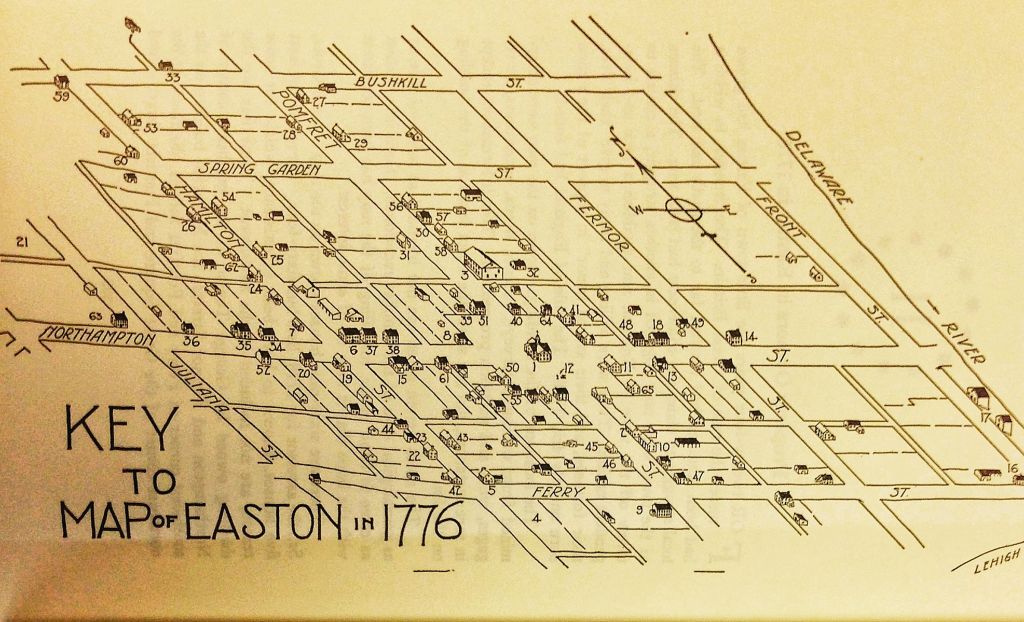
Earliest Map of Easton I could find 1763 – End of the French and Indian War
End of the French and Indian War British victory solidifies control over North America but increases tensions with Native American tribes and colonial settlers.
1765 – The Stamp Act is passed
The Stamp Act is passed Imposing direct taxes on the colonies, sparking widespread protests, including those in Pennsylvania.
1770 – The Boston Massacre
The Boston Massacre heightens revolutionary fervor across the colonies.
1774 – The First Continental Congress meets in Philadelphia, with Pennsylvania playing a key role in the movement toward independence.
1775 – The Revolutionary War begins at Lexington and Concord; local Pennsylvania militias begin organizing for defense.
1775 – The Revolutionary War Begins
The fires of revolution ignited in 1775 as shots rang out in Massachusetts, marking the beginning of the American Revolution. Across the colonies, towns like Easton, Pennsylvania, felt the growing call to arms. The war was no longer a distant conflict—it was a reality that would soon reach the Bush family.
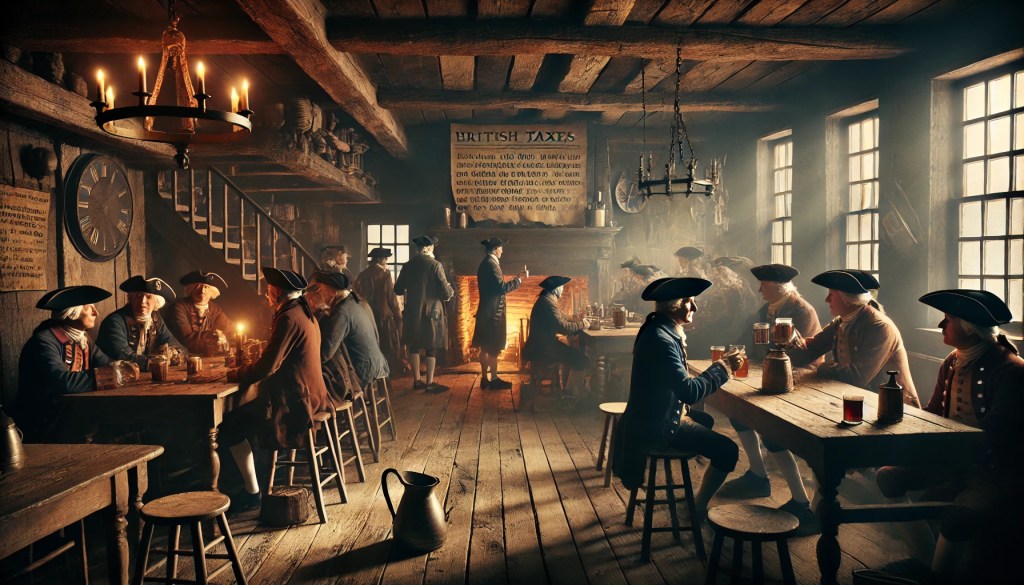
“The Rising Tide of Revolution” – Easton, Pennsylvania, 1775
In the dim glow of a colonial tavern, local Patriot militia members gather over tankards of ale, debating the future of the American colonies. Maps, newspapers, and whispers of rebellion fill the air as tensions with the British mount. Soon, these men would trade words for muskets in the fight for independence.1776 Spring – The Northampton County Militia
The Northampton County Militia begins drilling and organizing in preparation for potential British invasions.
1766 – The Declaration of Independence is Signed
The Continental Congress finalizes the Declaration of Independence in Philadelphia, only a short distance from Easton.
1776 July 8 – Easton holds a patriotic rally
Declaration of Independence is read aloud
1776 July 9 – Henry Bush and his father enlist
Henry Bush and his father enlisting the Northampton County Flying Camp
1776 July Early – Pennsylvania’s militia regiments
Pennsylvania’s militia regiments, including Northampton County’s, are ordered to mobilize in response to British troop movements in New York.
1776 July – Henry Trains
Henry and his fellow recruits train in Pennsylvania before marching toward New York to join General Washington’s army.
Henry and his fellow recruits train in Pennsylvania before marching toward New York to join General Washington’s army.
1776 Late July – The Northampton County Militia
The Northampton County Militia arrives on Long Island, where they are integrated into defensive positions under Washington’s command.
1776 August – Skirmishes with British and Hessian forces Skirmishes with British and Hessian forces escalate as they prepare for a large-scale attack. On August 22, the British under General William Howe land 15,000 troops on Long Island, bolstered by 9,000 Hessian mercenaries. Washington’s forces, including the Northampton County Militia, take defensive positions in Brooklyn Heights.
1776 August 26-27 – Battle of Long Island (Battle of Brooklyn) Battle of Long Island unfolds. British forces, using flanking maneuvers through Jamaica Pass, overwhelm the American defenses. Henry Bush and his unit fight in the rear guard action as Washington attempts a retreat.
1776 August 29, – Washington Retreats
Washington orders a miraculous nighttime evacuation across the East River, saving the Continental Army. However, many troops, including Henry Bush, are unable to escape and are captured by British forces.
1776 September – December
Henry is held aboard a British prison ship, likely the infamous HMS Jersey, in New York Harbor, where prisoners face starvation, disease, and brutal conditions. Mortality rates exceed 60% among captured soldiers.
1776 November 16, – Battle of Fort Washington
Johann Georg Busch is wounded.
1776 December – 1777 January – Due to overcrowding and deteriorating conditions, Henry and other prisoners are transferred to land-based confinement, where he finds an opportunity to escape.
1776 December – 1777 January – Due to overcrowding and deteriorating conditions, Henry and other prisoners are transferred to land-based confinement, where he finds an opportunity to escape.
1777 January – Escape
After enduring harsh conditions aboard a British prison ship, Henry Bush is transferred to a mainland facility. Using the confusion during a prisoner relocation, he successfully escapes captivity and makes his way through enemy-occupied New York.
February 1777 – Following his escape, Henry Bush returns to Easton, Pennsylvania, where he regroups with local militias. During this time, Pennsylvania is a hotspot of revolutionary activity, with British forces focusing on controlling key areas of the Delaware River Valley.
1777 July-September – The British launch their Philadelphia Campaign, aiming to capture the revolutionary capital.
September 11, 1777 – The Battle of Brandywine
The Battle of Brandywine sees a decisive British victory, forcing the Continental Congress to evacuate Philadelphia. Henry’s militia unit is likely involved in the defensive efforts.
October 4, 1777 – The Battle of Germantown takes place as Washington attempts to retake Philadelphia. Despite initial success, the Continental Army is repelled, and British control over the city is solidified.
Winter 1777-1778 – The Continental Army endures the harsh winter at Valley Forge, just west of Philadelphia. While Henry Bush’s exact whereabouts are unknown, Pennsylvania militias are called upon to support the effort, providing supplies and local defense.
June 1778 – The Battle of Monmouth results in a standoff between Washington’s forces and the British. Henry and other militia forces in Pennsylvania continue operations against British foraging parties and loyalist factions.
1779 May 7–June 18 – Maj. Gen. John Sullivan
Maj. Gen. John Sullivan and the Occupation of Easton, Pennsylvania.
1779 June-October – Sullivan’s Expedition
The war shifts focus to New York and the frontier. Pennsylvania militia units, including men from Easton, take part in Sullivan’s Expedition , a campaign to neutralize Iroquois Confederacy tribes allied with the British.
1779 July – Death of Johann Georg Busch
Death of Johann Georg Busch due to war injuries.
1780 November 14 – Henry Bush marries Catharine Dolson
Henry Bush marries Catharine Dolson in Easton, Pennsylvania.
1781 – Henry Bush serves as an Ensign
Henry Bush serves as an Ensign in Pennsylvania militia against British-allied forces
June 1781 – The Pennsylvania militia
The Pennsylvania militia, including Henry Bush, is stationed near Stroudsburg and the Delaware River, defending settlements from raids by British-allied forces and Native American warriors.
1781 July – Susquehanna River
Engages in skirmishes along the Susquehanna River, as part of local militia forces protecting frontier settlements.
Fall 1781 – Siege of Yorktown
Henry Bush’s unit supports supply and communication lines for Washington’s main army as it prepares for the Siege of Yorktown.
October 1781 – British surrender at Yorktown
News of the British surrender at Yorktown reaches Pennsylvania, marking the beginning of the end of the war.
1782 – Henry Bush continues serving in the militia, conducting patrols along the Pennsylvania frontier to protect settlers from post-war Loyalist and Native American attacks.
1783 – War Ending
With the war formally ending, Henry Bush returns to Easton and transitions to civilian life.
1783 September 3 – The Treaty of Paris
The Treaty of Paris is signed, officially ending the Revolutionary War and securing American independence.
1784 – Henry Bush returns to civilian life
Henry Bush returns to civilian life in Easton, Pennsylvania, where he likely engages in farming and land acquisition.
1792 – Birth of Henry Bush Jr.
1796-1797 (approx) – Coline New York
Henry Bush and his family settle in Caroline, New York
1797 January 18 – Birth of Richard Bush, noted as the first white child born in Caroline
1801 (approx) – Richard Bush opens Bush’s Tavern
Henry’s son, opens Bush’s Tavern in Caroline
1811 April – First town meeting of Caroline is held in Bush’s Tavern
1817 – Tompkins County is formed
Henry now resides within its boundaries
1820s (approx) – Henry relocates to Peruville, Groton, New York
1834 – Henry Bush petitions for a pension
Henry Bush petitions for a pension for his Revolutionary War service
1835 – Henry and Catharine Bush sell their farm
Henry and Catharine Bush sell their farm and move in with their son
1836 – Death of Catharine Dolson Bush
1839 April 6 – Death of Henry Bush
Death of Henry Bush in Peruville, New York
1839 – Henry is buried in Peruville Cemetery
Henry is buried in Peruville Cemetery with a tombstone marking him as a Revolutionary War soldier
 The Patriot Legacy Project